Iron-cascade drive
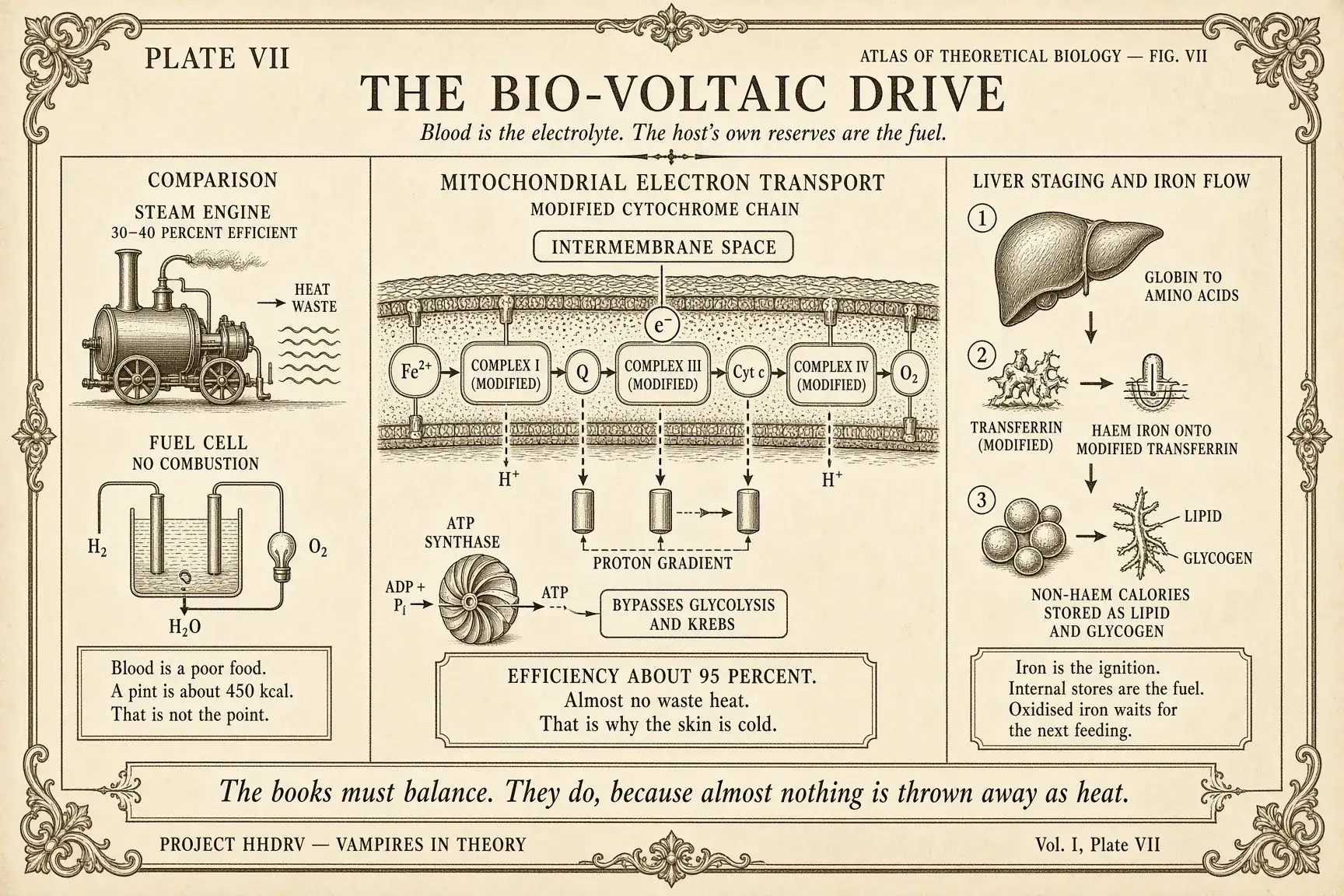
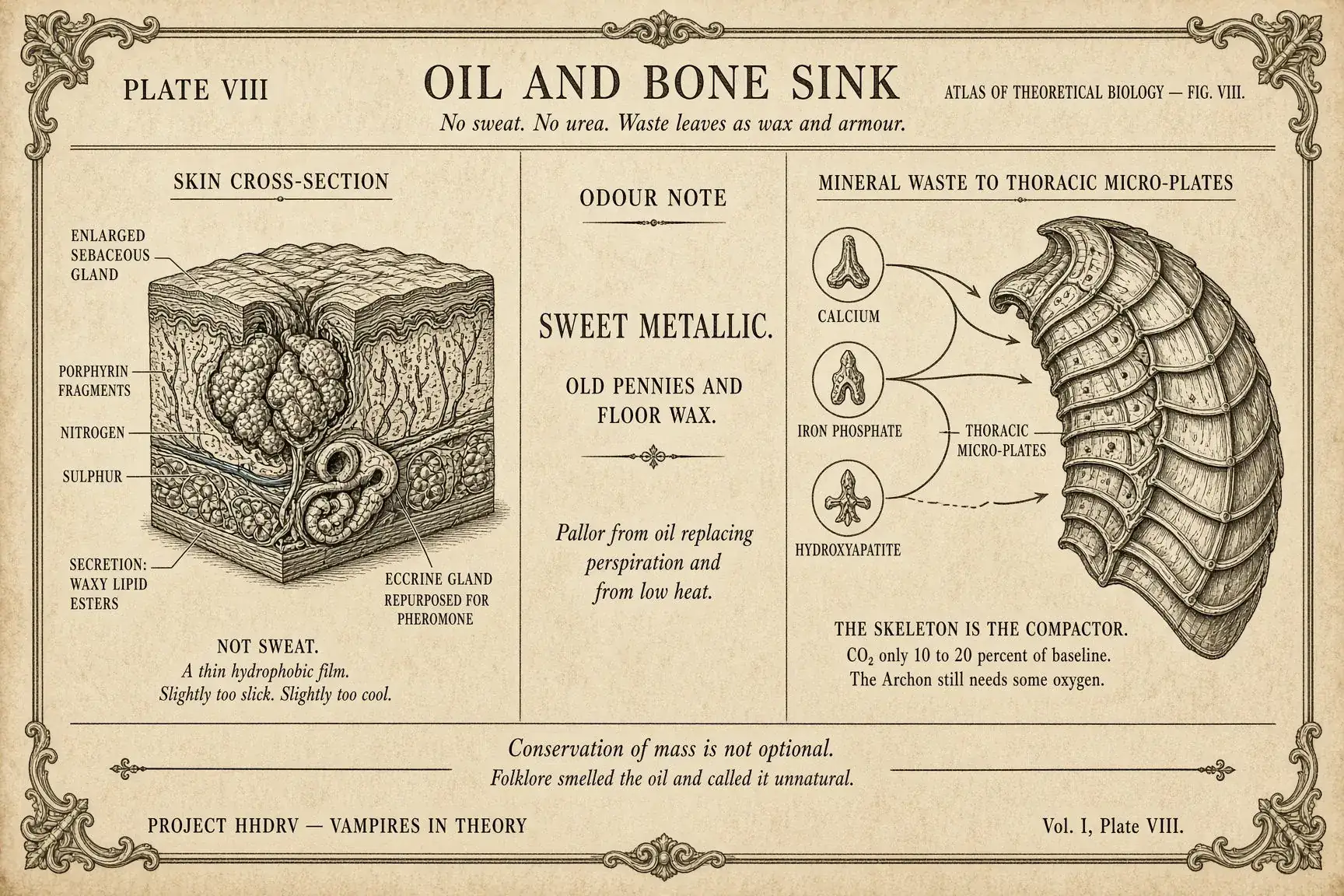
Haem-dependent bio-voltaic metabolism. The organism does not merely drink blood. It runs an iron-centred energy cascade whose waste products explain both the skeletal armour and the porphyric photosensitivity.
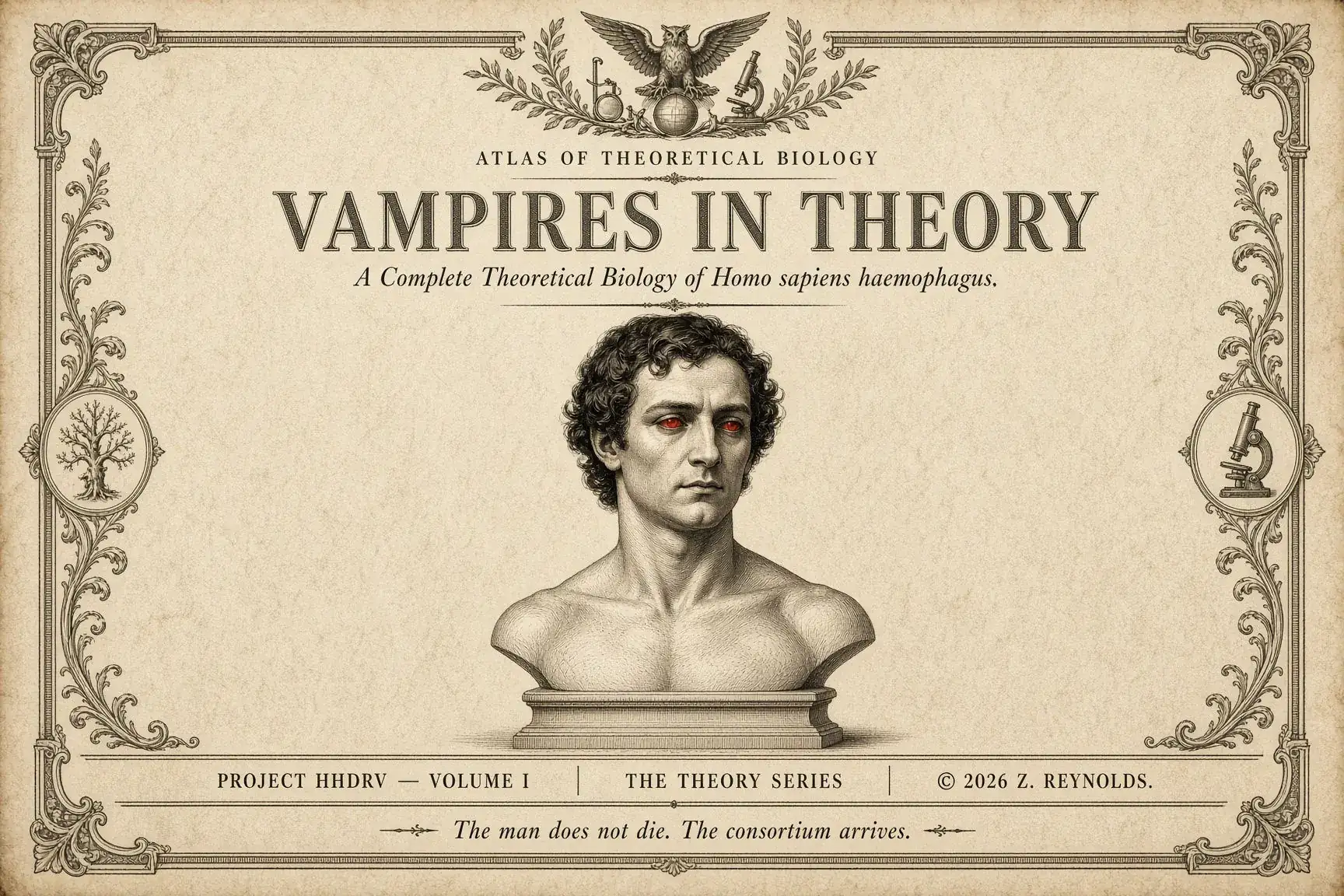
PROJECT HHDRV
A Complete Theoretical Biology of Homo sapiens haemophagus
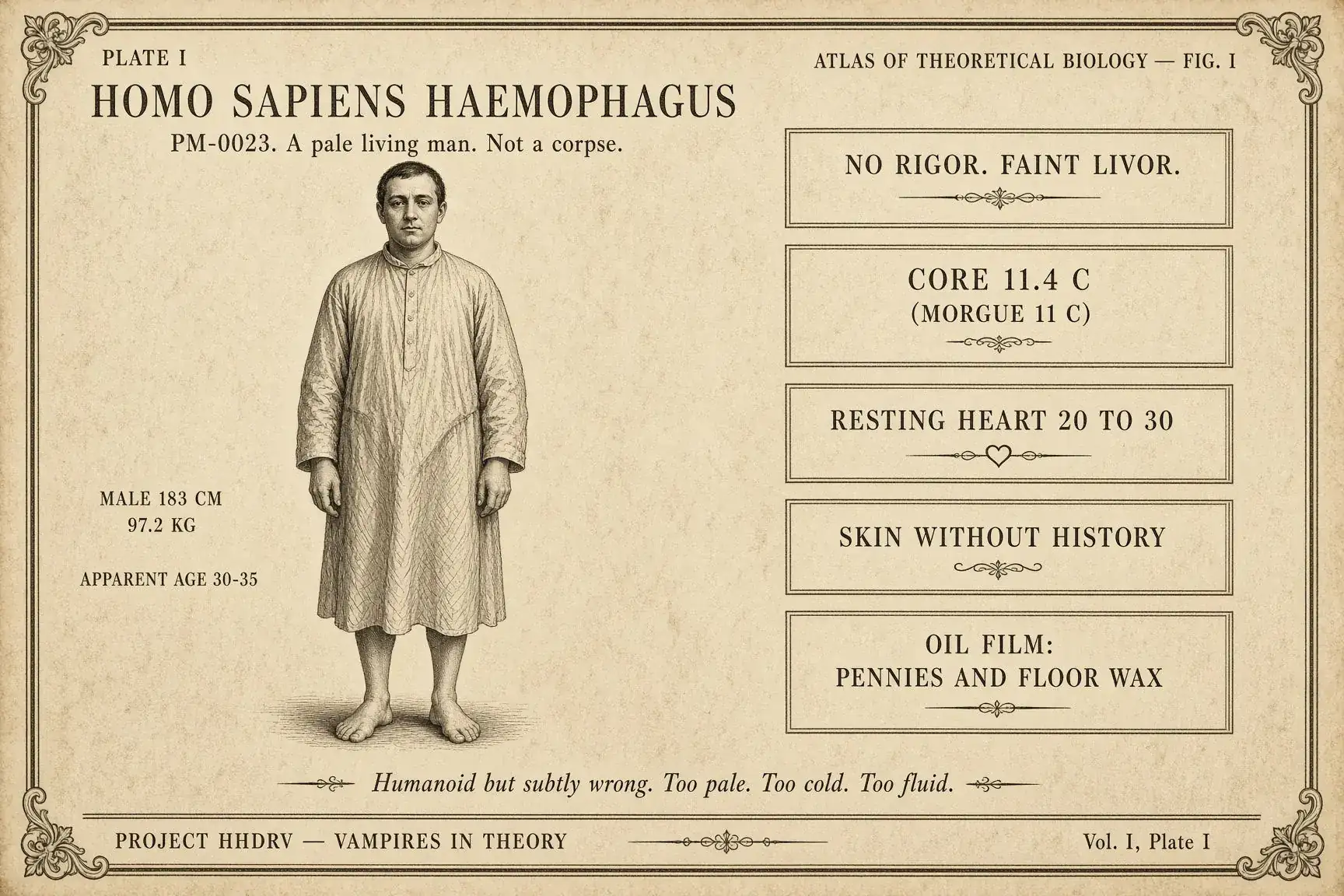
Homo sapiens haemophagus
This page is a covering note for the printed book. It is not the novel. If you have never opened the series, start with the paragraphs below.
This is Book 1 of the Theory Series. It is not a novel and not a folklore survey. It is a theoretical-biology reconstruction of the organism the stories called vampire — treated as a living system whose symptoms were written down badly, for a very long time.
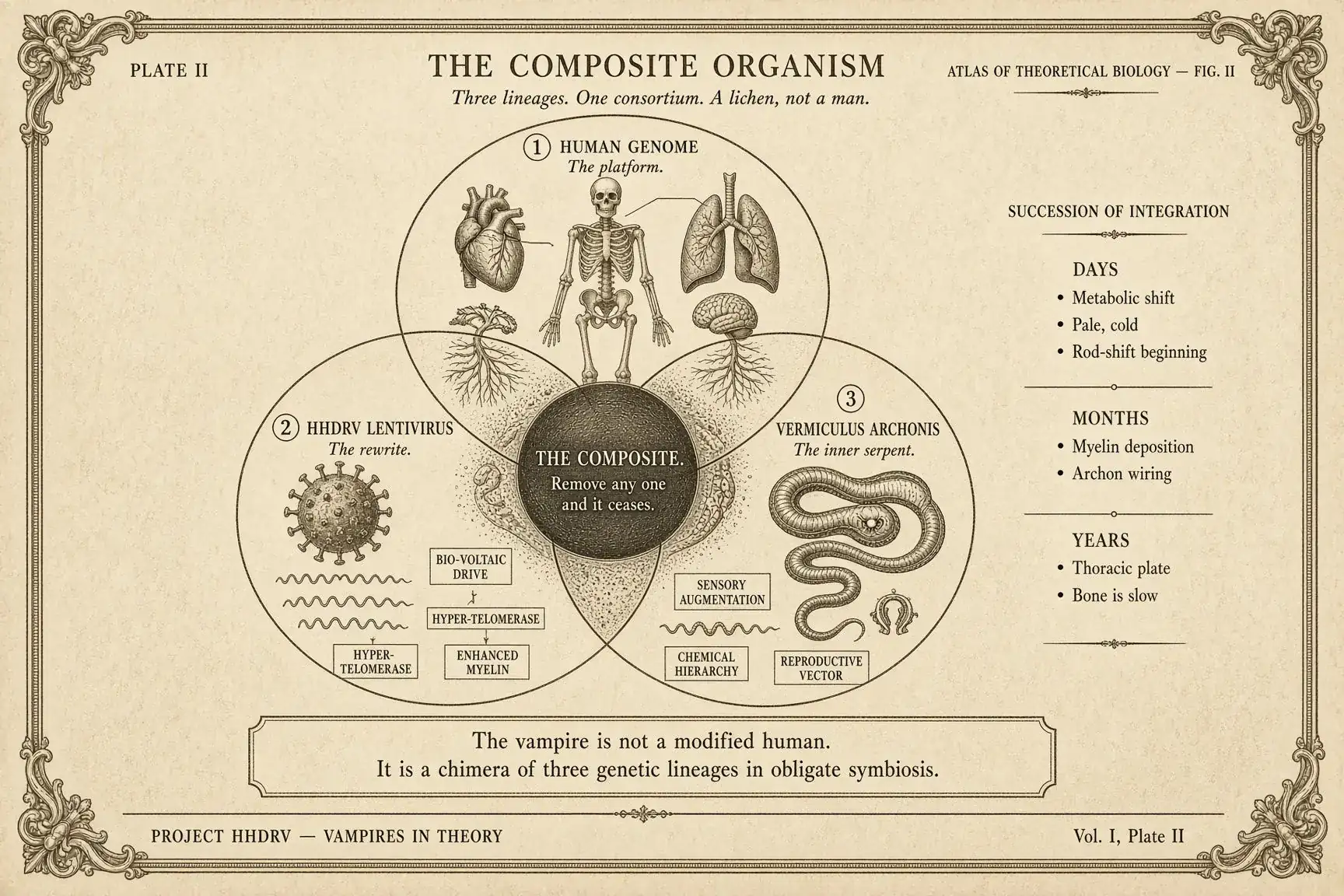
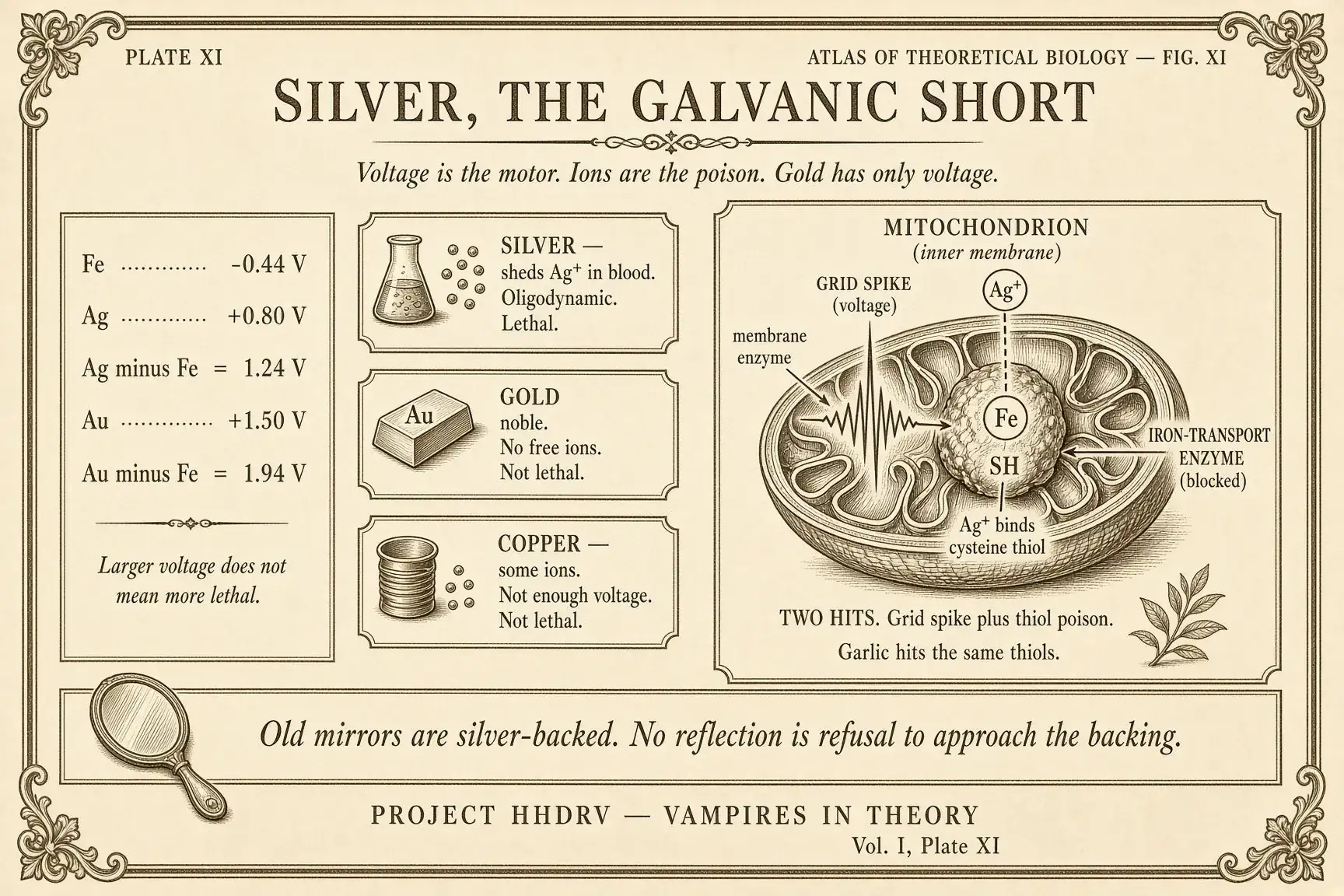
The claim is clinical. Homo sapiens haemophagus is a composite: a human host, a lentiviral modification, and a nematode colony occupying the brainstem. It does not drink blood as a habit. It runs an iron-centred energy cascade. Silver at 1.24 volts is a galvanic short-circuit, not a blessing. Sunlight ignites porphyric waste in the skin. The fangs are what witnesses remember. The feeding organ is a retractable proboscis coiled beneath the tongue.
You need no other volume to begin. The printed book is the full derivation (about 83,000 words). This page is the covering note: contents, recovered passages, named mechanisms. If the register feels like a declassified file, that is the form. The copyright is ordinary. The biology is the argument.
New to the series? Four steps for a first reader. The printed volumes remain the full texts.
The claim
Vampires are a composite organism: human host, lentiviral retroviral modification, and a Vermiculus archonis nematode colony. An iron-dependent bio-voltaic metabolic drive. Managed predation. A hidden empire.
Dedication, as printed
For [REDACTED], parasitologist. The Verdun site was his idea. The question was worth asking.
Who is speaking
Compiler A is a voice inside the book, not a second author. The dedication is to a missing colleague in that fiction — a parasitologist whose absence the document treats as evidence. Copyright is Z. Reynolds.
A page from the printed volume, so you can hear the register before you buy the book.
This document does not know exactly when the first vampire was made. It does not know where. It does not know the precise circumstances, the name of the individual, the year, or the specific field of dead and dying men in which the conditions for transformation were first accidentally met. The honest scientific position, after exhaustive theoretical analysis, is this: we cannot pinpoint the origin with certainty. What we can say, with considerably more confidence than we can identify a date or a name, is what kind of place the origin required. Multiple independent lines of reasoning converge on a single type of environment: a site of mass human death.
A psychological archetype explains why multiple cultures might independently produce a dead thing that feeds on the living. It does not explain why those cultures would independently produce the same specific list of biological attributes, the same specific set of countermeasures, and the same specific behavioural observations, too mechanistically precise and too practically functional to have been generated by symbolic thinking. Archetypes are thematically consistent but mechanistically vague. Biological observations are the reverse. The vampire myth passes this test decisively.
Science pillars
Haem-dependent bio-voltaic metabolism. The organism does not merely drink blood. It runs an iron-centred energy cascade whose waste products explain both the skeletal armour and the porphyric photosensitivity.
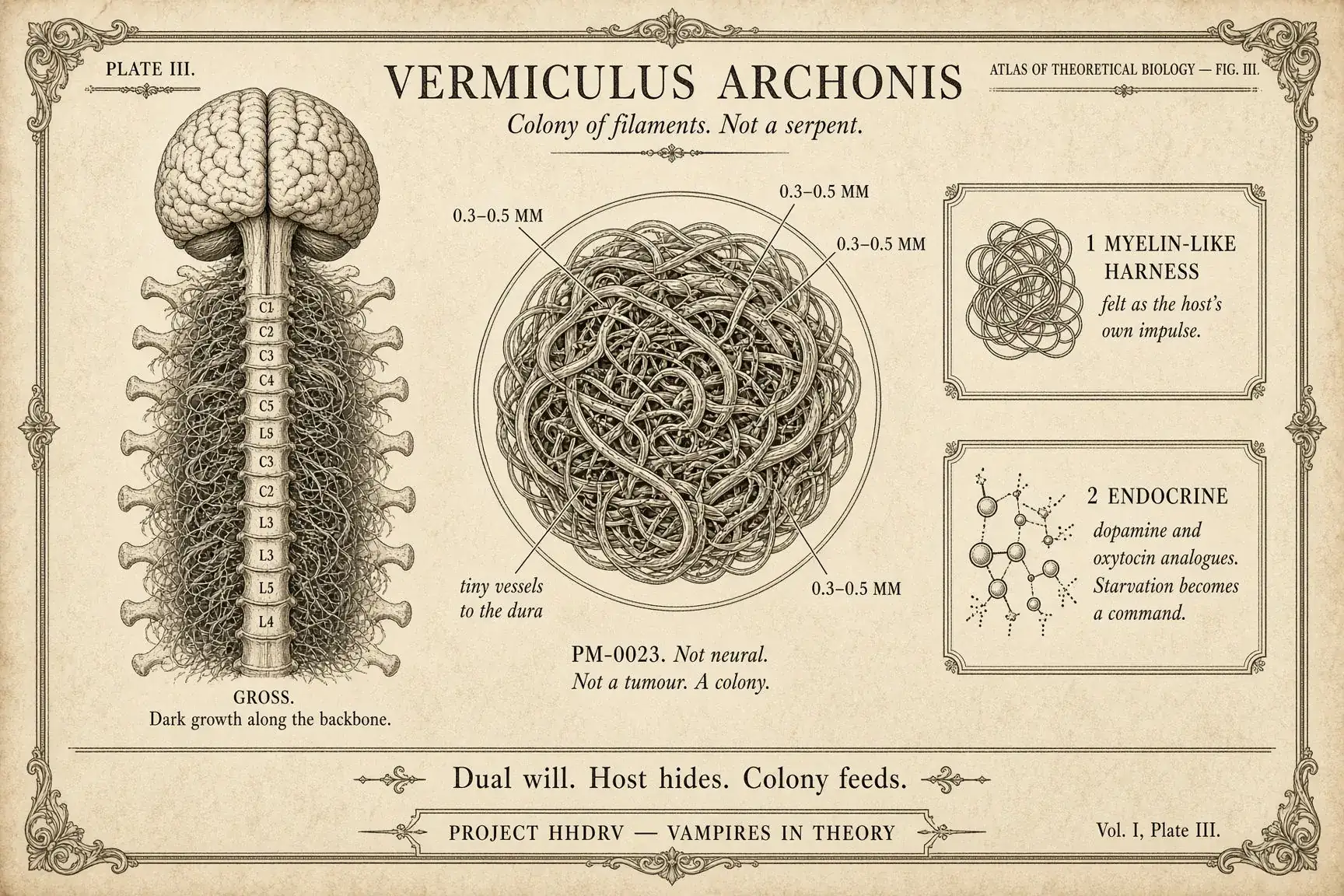
Vermiculus archonis occupies the brainstem and spinal canal. Quorum sensing, not a solitary parasite. The host is a composite.
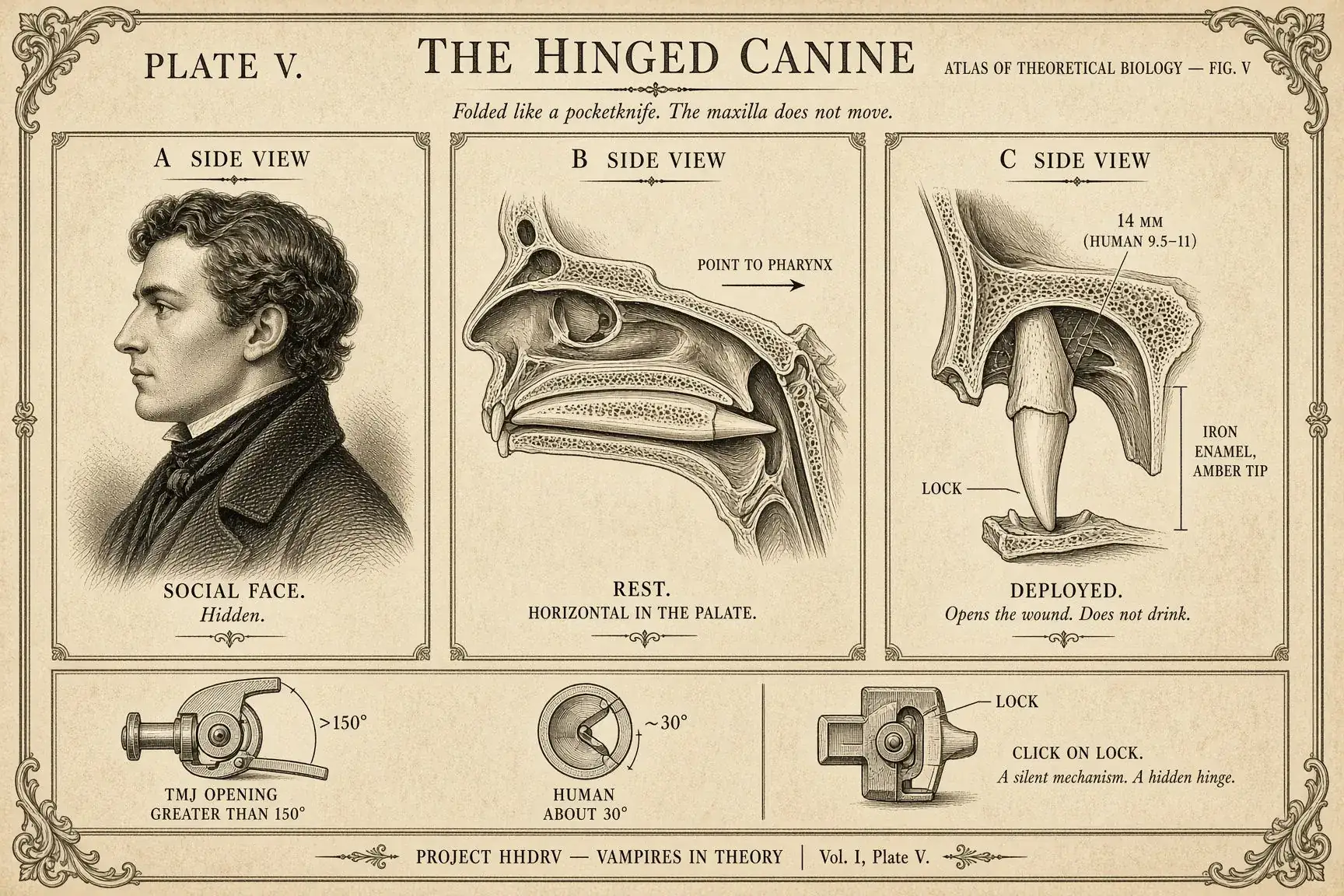
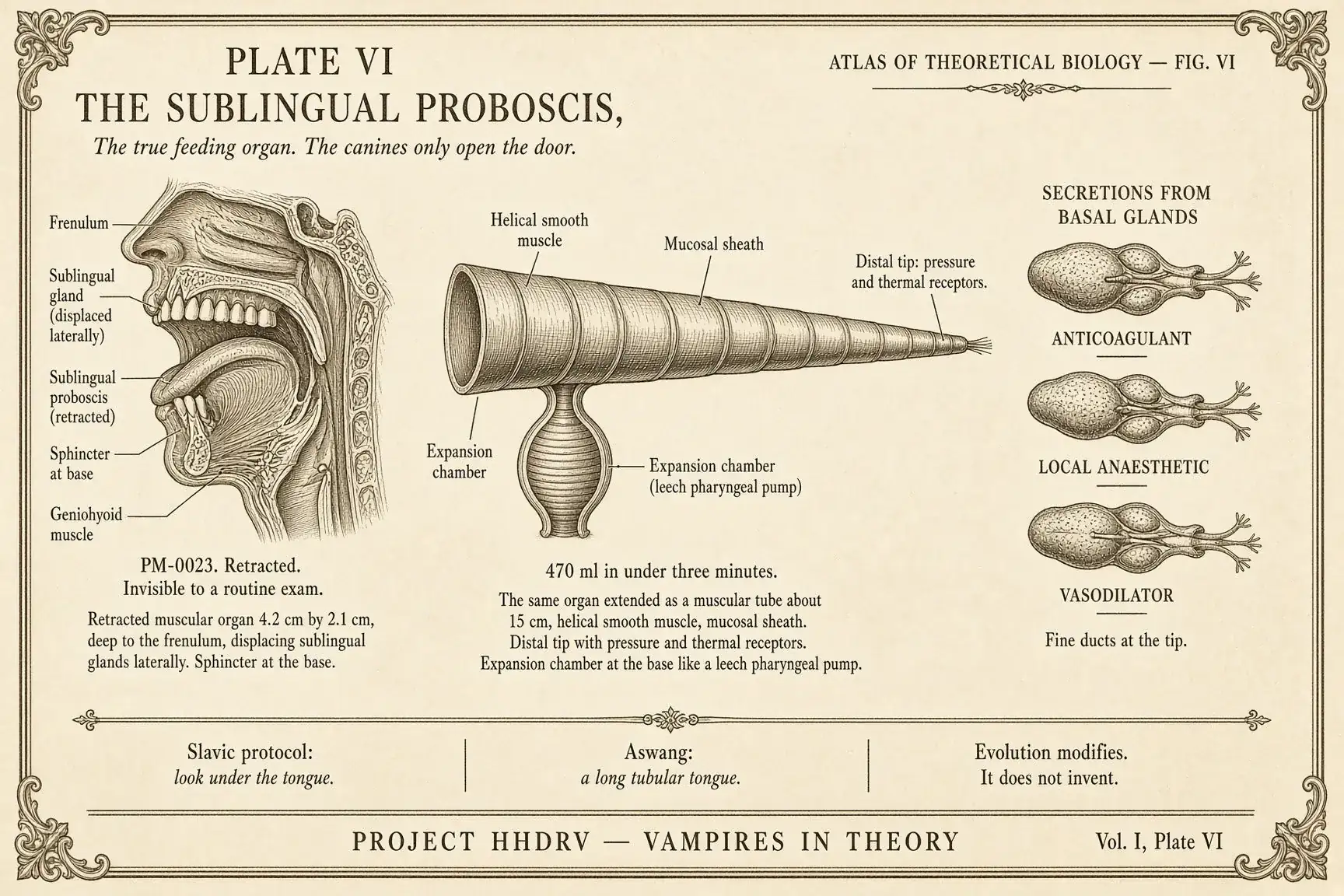
The fangs are not the feeding organ. A muscular, retractable structure coiled beneath the tongue is. Folklore recorded the accessory. It missed the instrument.
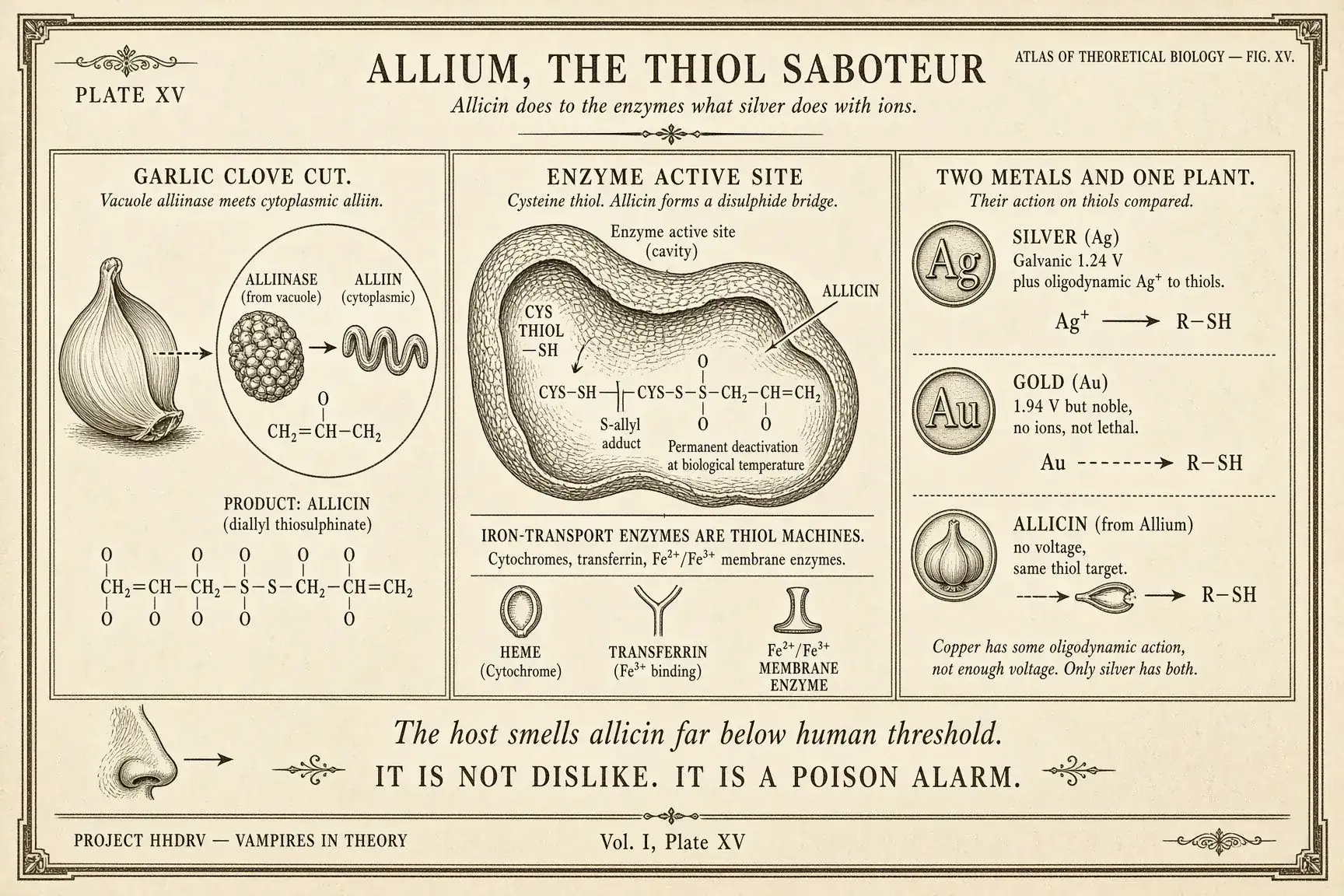
Not holiness. A galvanic short-circuit across iron-sulphur cluster enzymes in the bio-voltaic chain. Undergraduate electrochemistry, applied with prejudice.
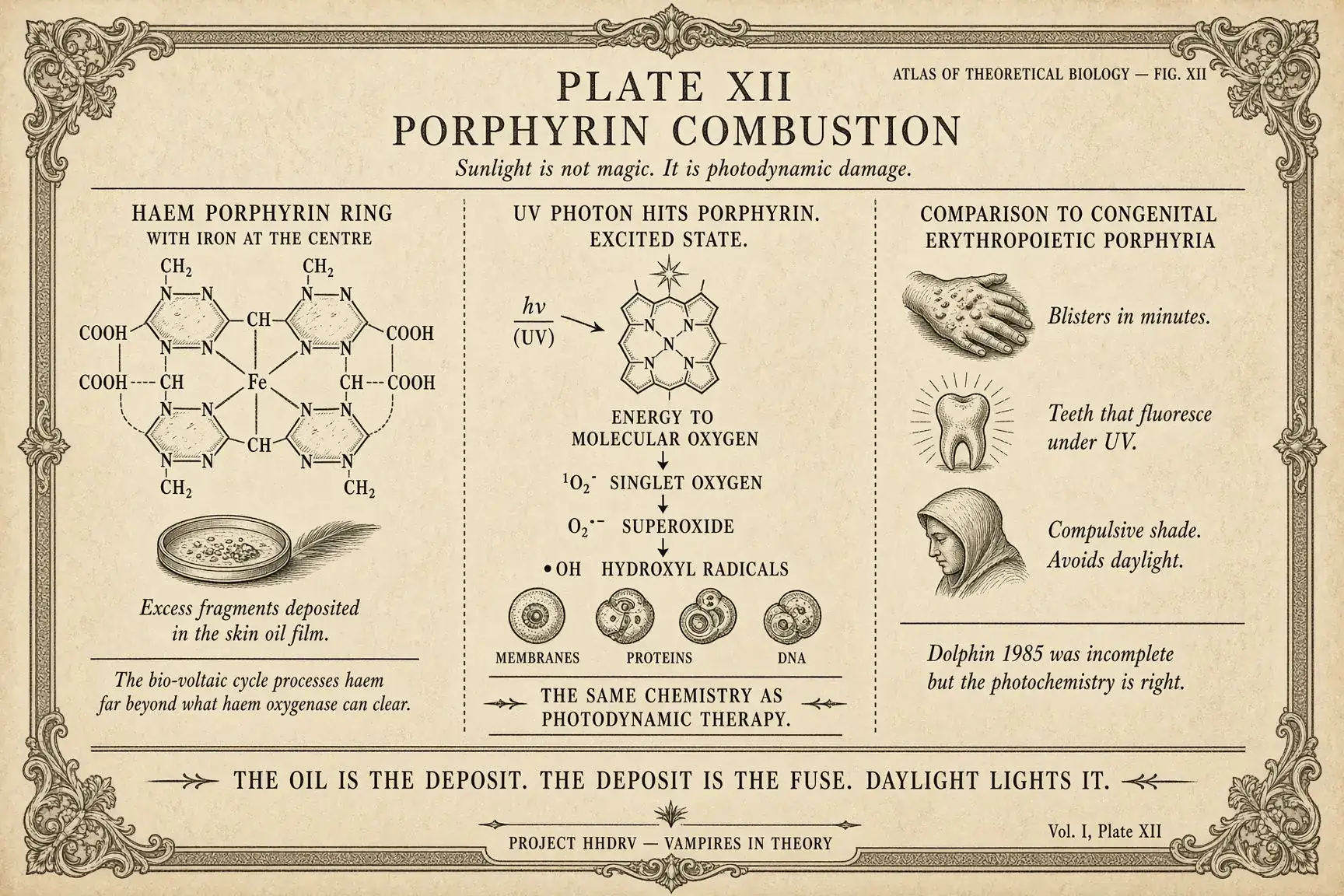
Sunlight is a photochemical event, not a moral one. Accumulated porphyric oil in the dermis ignites under the Soret band.
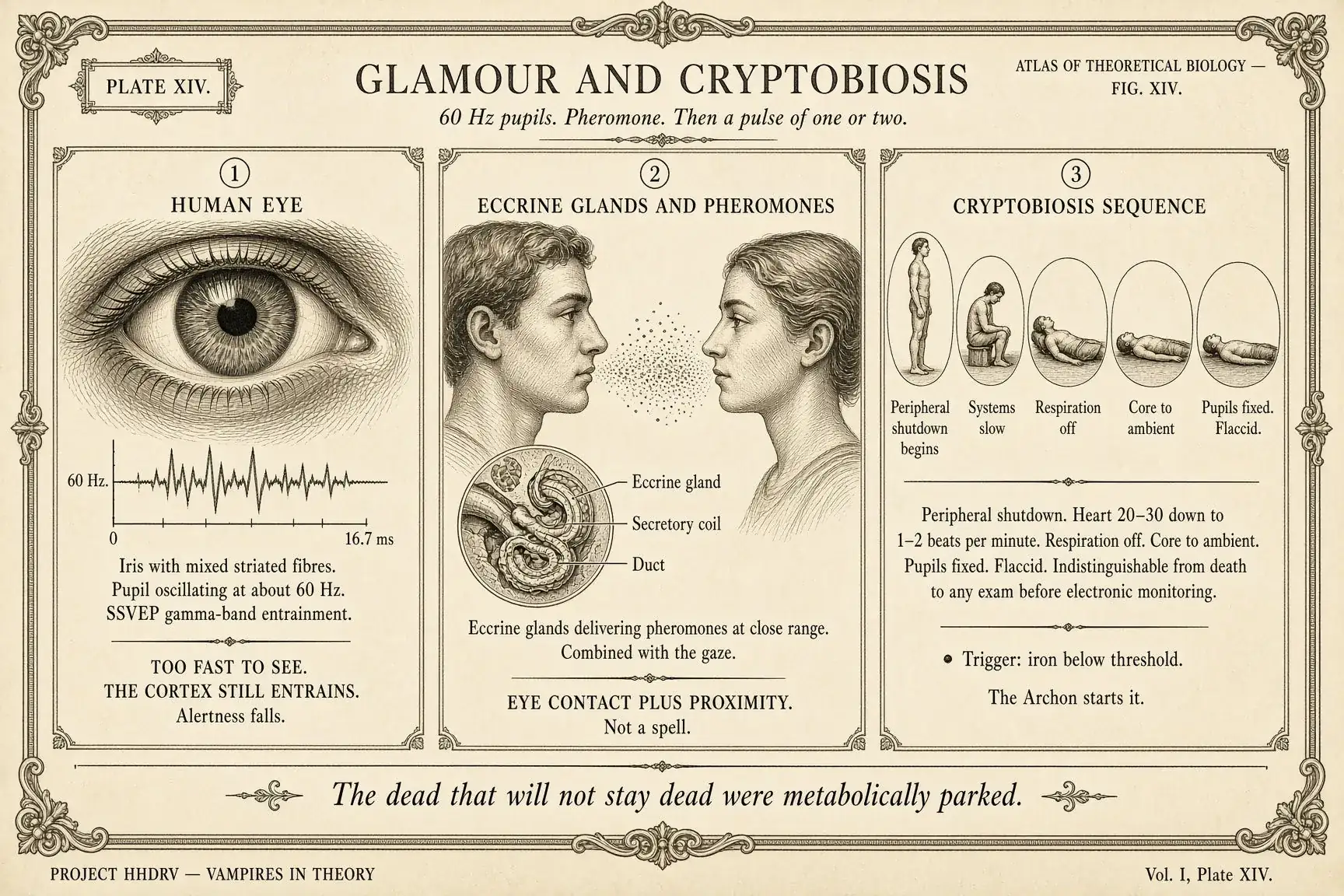
A weaponised androstenediol-analogue pheromone. Inhaled, it suppresses threat-detection centres. Magic, in the clinical sense, is chemistry that works on a nervous system.
From this volume
Organism · HHDRV Ch. 6
A cursed man. A single predator wearing a human face.
Spinal canal · HHDRV Ch. 7
The inner serpent. Possession. A second will behind the eyes.
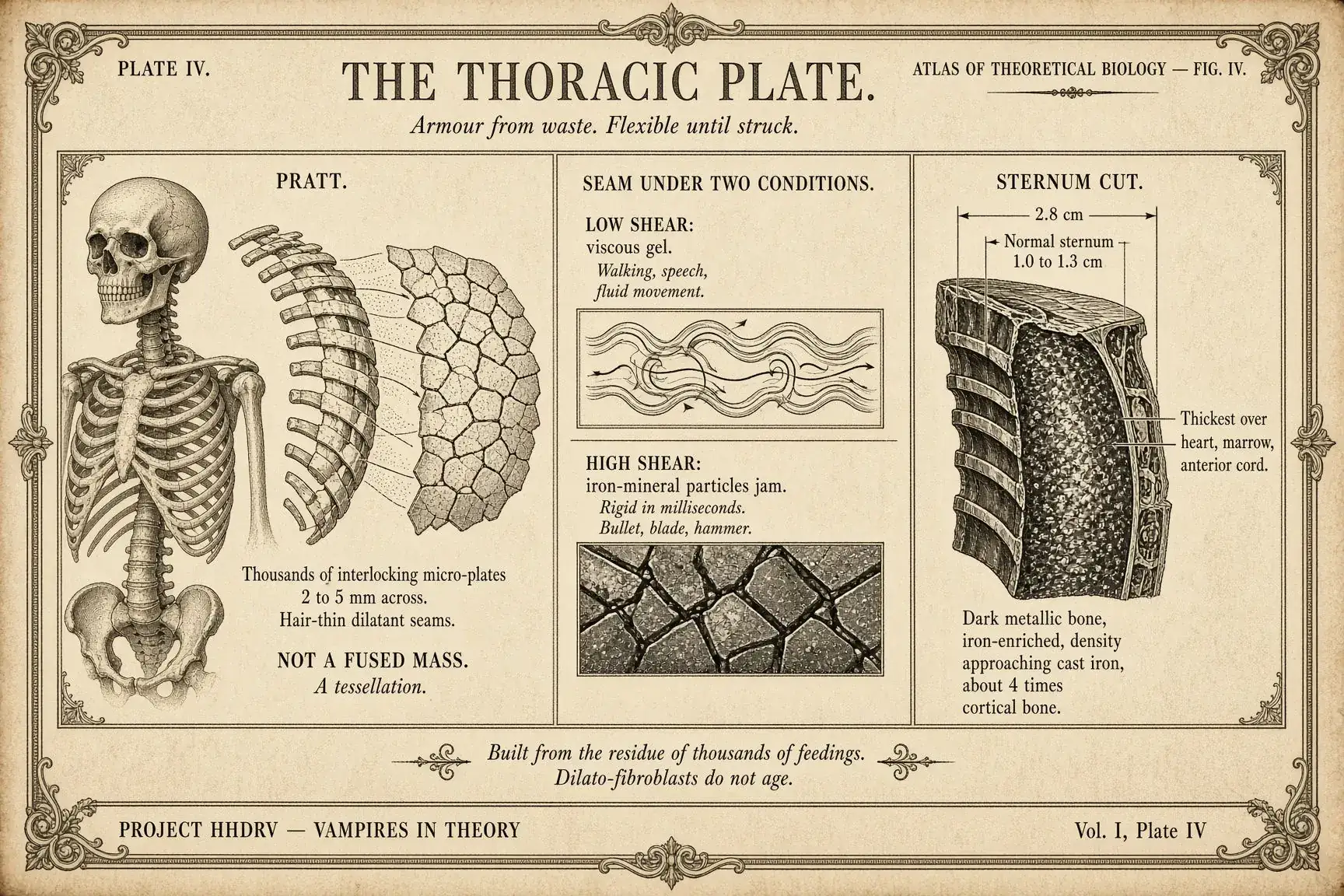
Thoracic cage · HHDRV Ch. 8
A body that does not break. The unkillable chest.
Maxillary canines · HHDRV Ch. 9
The fangs. Always the fangs.
Sublingual apparatus · HHDRV Ch. 10
The bite. Two punctures in the throat.
Mitochondrial membrane · HHDRV Ch. 12
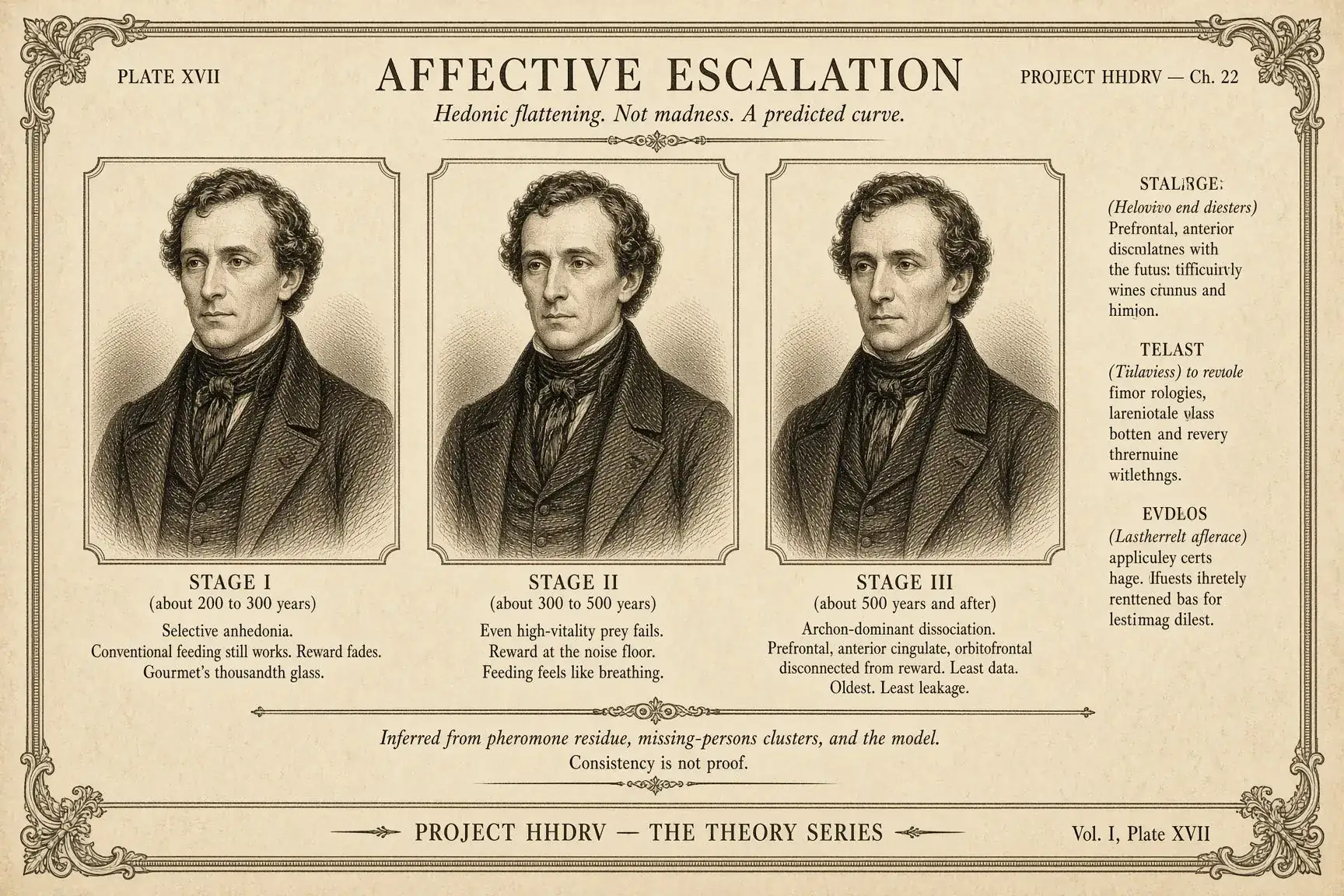
They drink blood to live. Hunger as appetite.
Dermis and bone · HHDRV Ch. 13
Pallor. A sweet-sick smell. No reflection in glass.
Telomeres · HHDRV Ch. 14
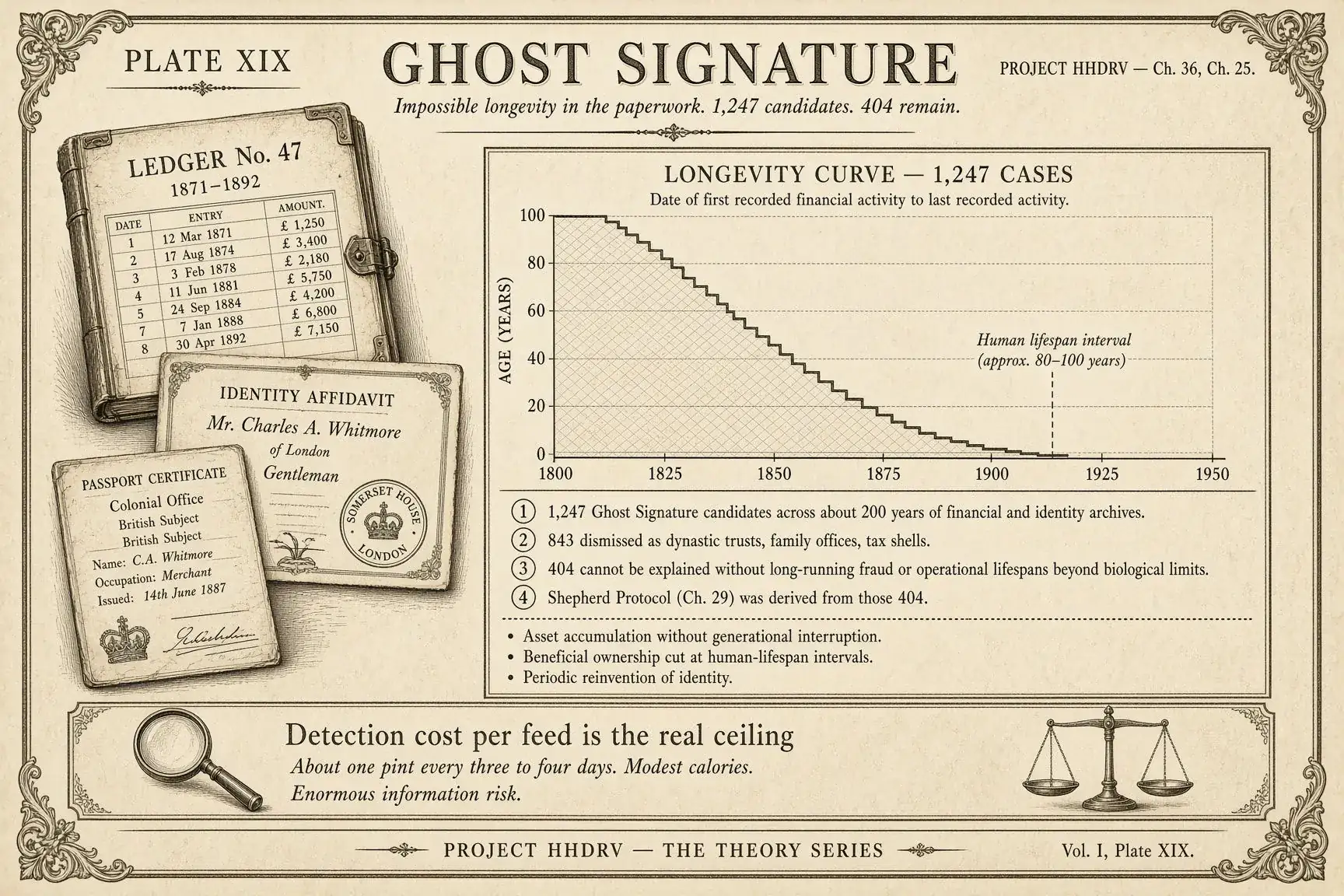
They do not age. They do not die of time.
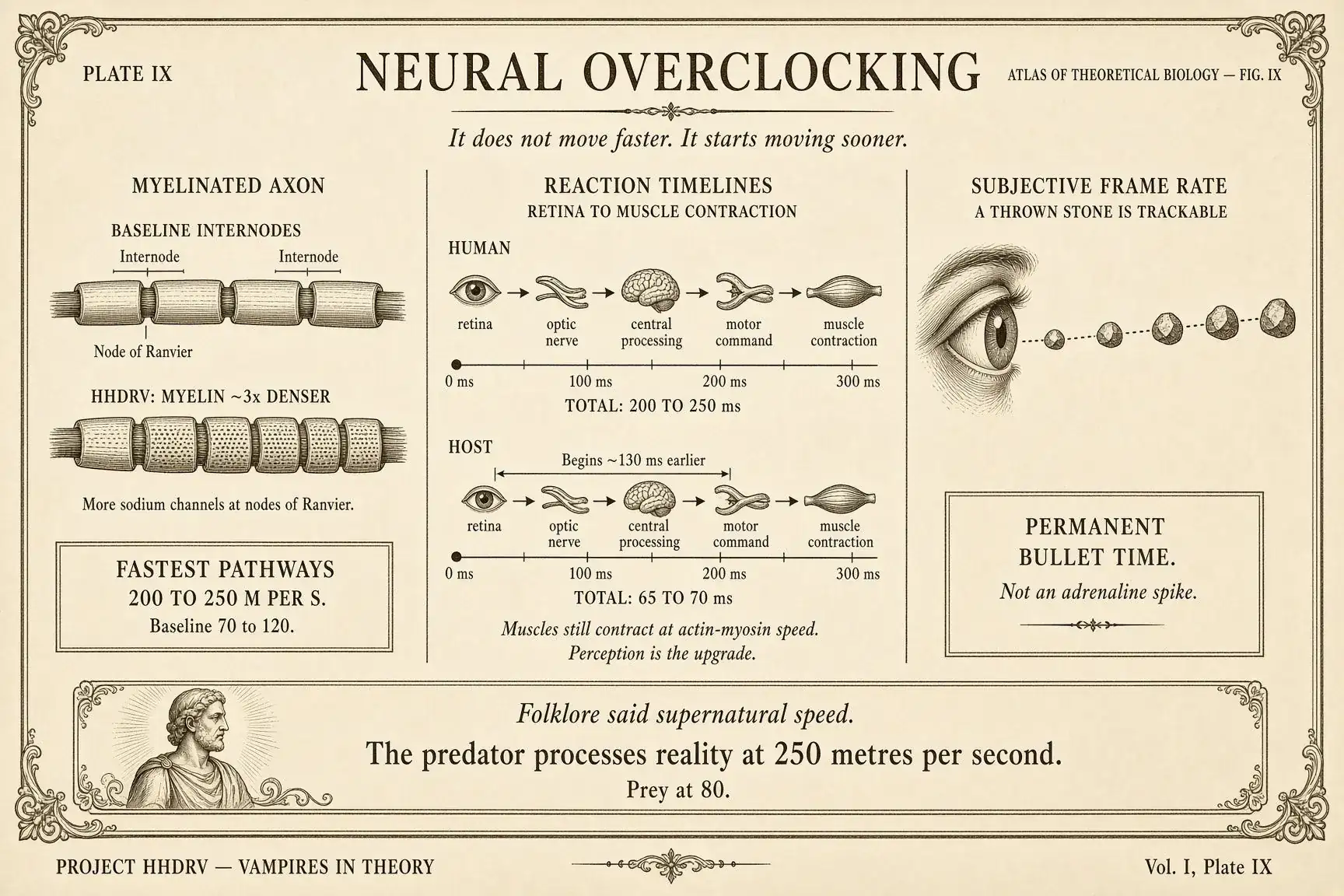
White matter · HHDRV Ch. 15
They move between the ticks of a clock. Bullet-time.
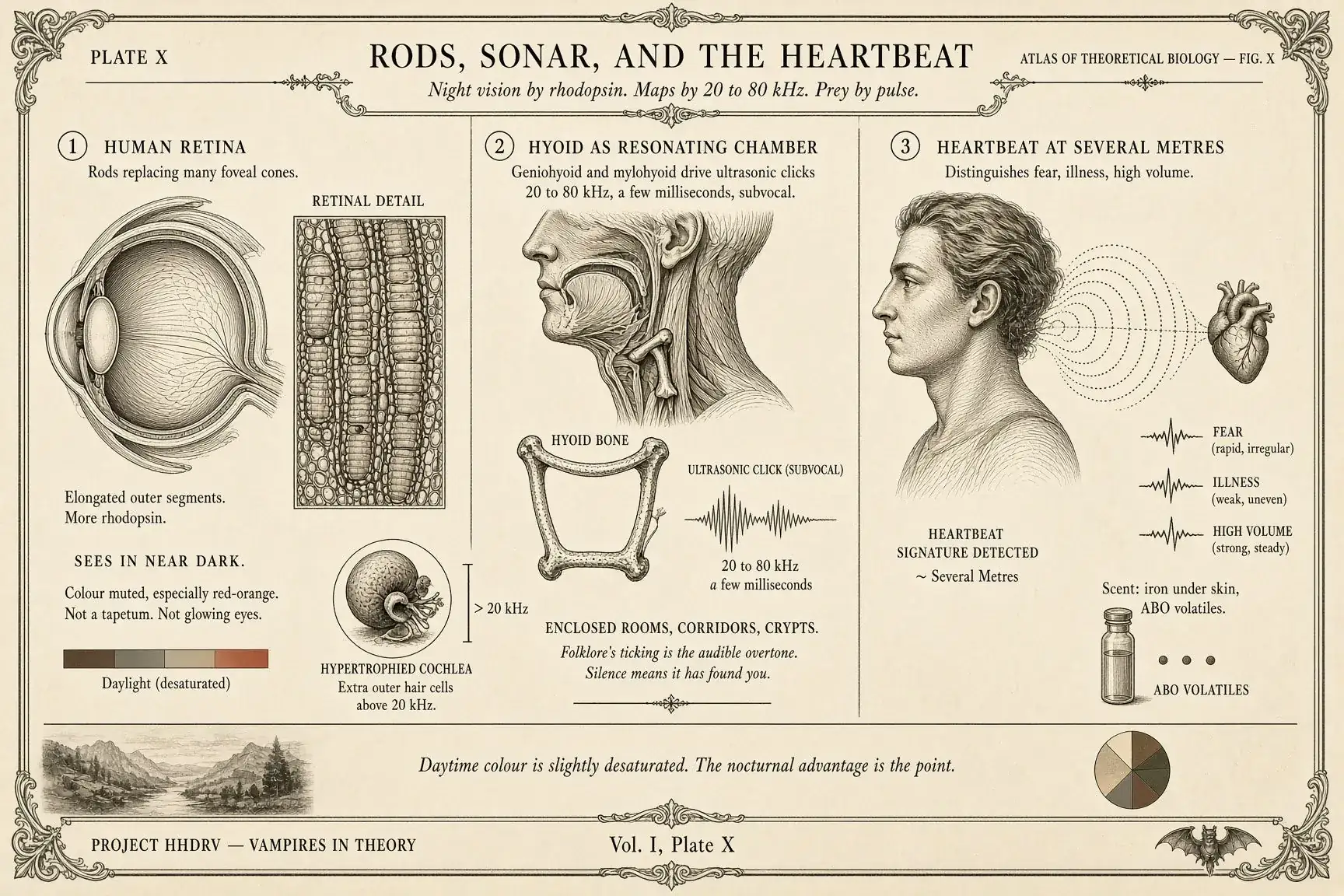
Cochlea and trigeminal field · HHDRV Ch. 16
They hunt without a lamp. They find you in unlit rooms.
Olfactory epithelium · HHDRV Ch. 17
Enchantment. You wanted to go with them.
Autonomic brainstem · HHDRV Ch. 18
The coffin. The corpse that was not.
Iron-sulphur clusters · HHDRV Ch. 19
The blessed metal. Holiness as metallurgy.
Dermal porphyrin film · HHDRV Ch. 20
Sunlight as judgement. Fire at dawn.
Thiol enzymes · HHDRV Ch. 23
Garlic at the threshold. Whole bulbs hung like a charm.
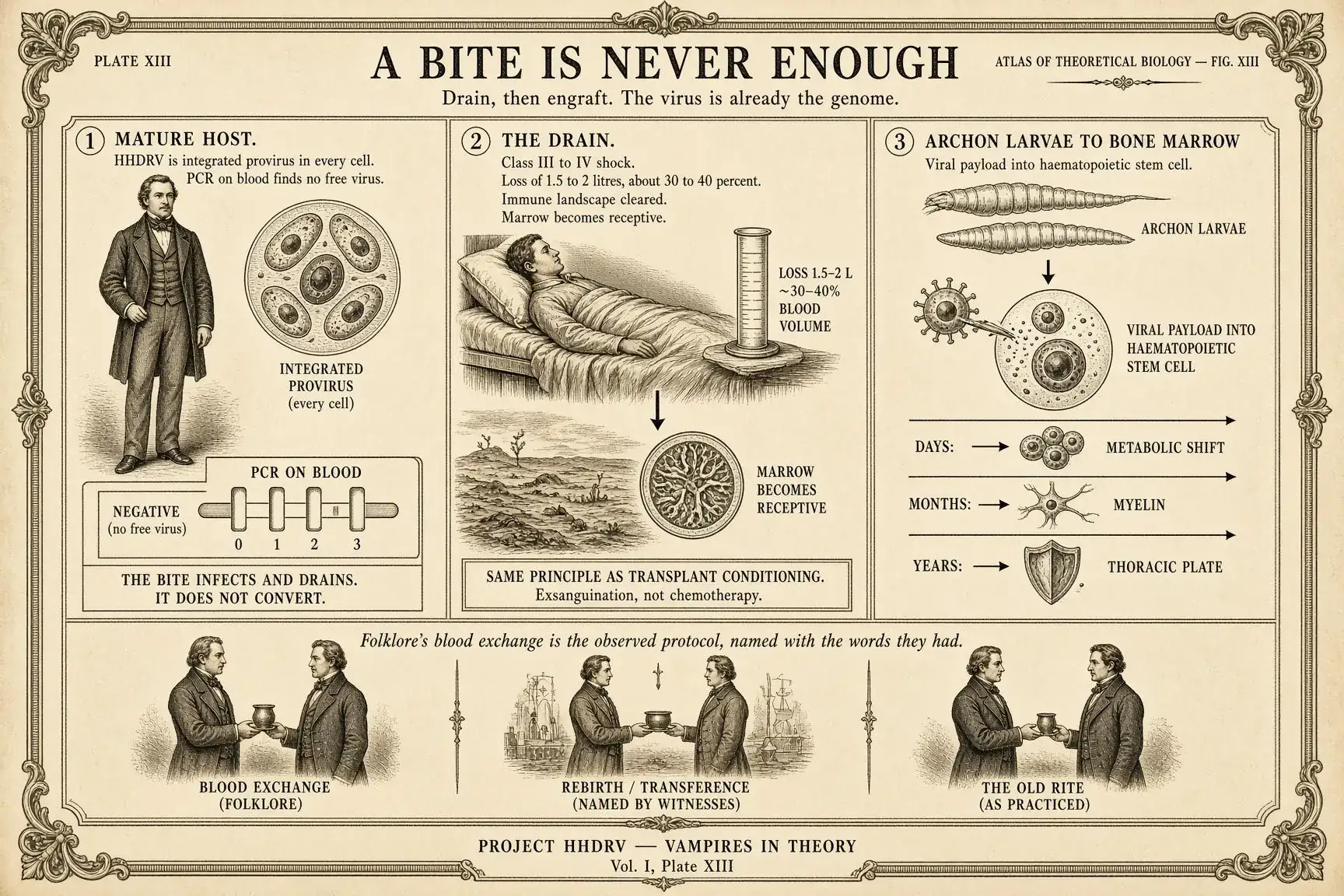
Circulating volume · HHDRV Ch. 32
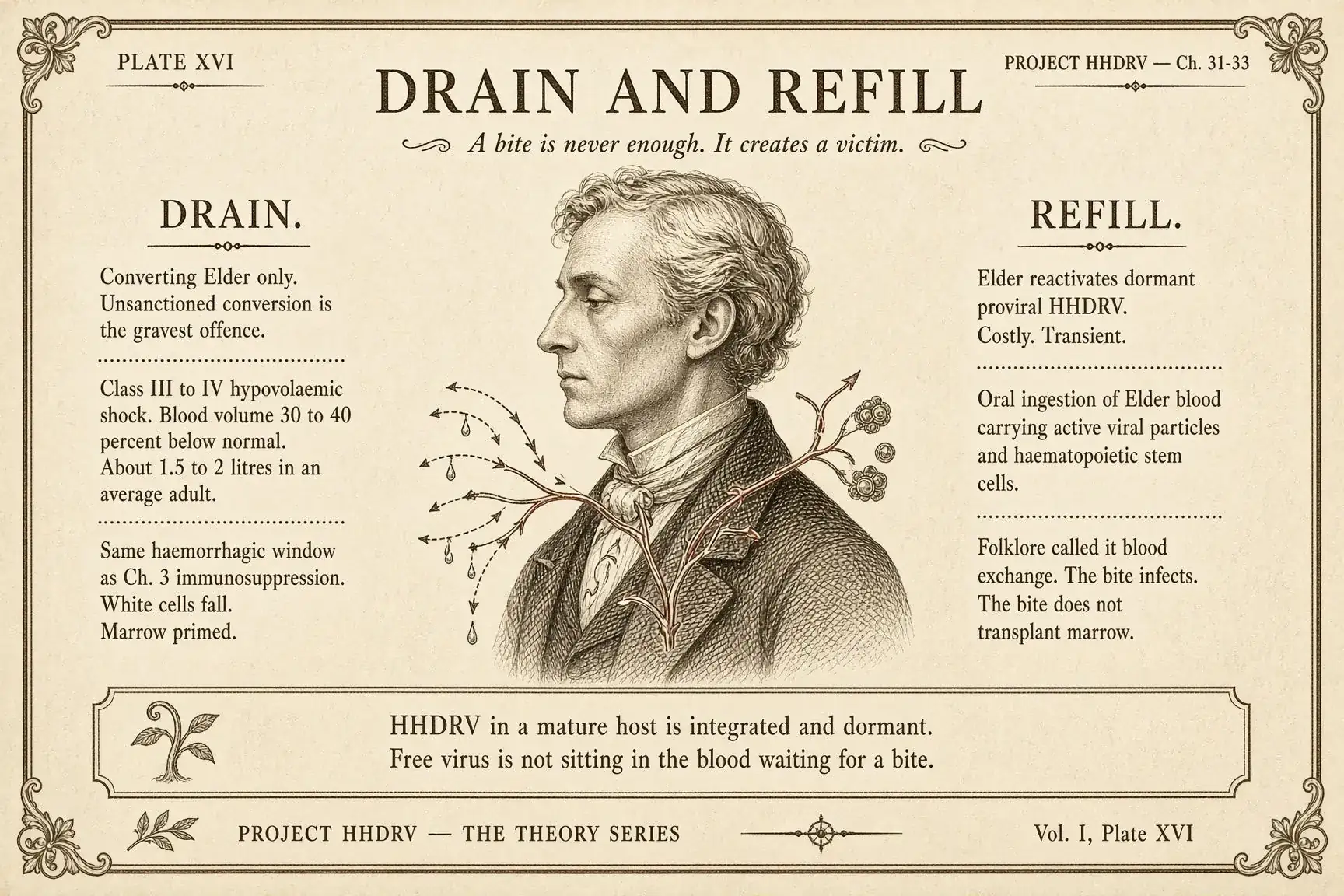
A bite is enough. One night and you wake changed.
Marrow and cribriform plate · HHDRV Ch. 33–34
The blood exchange. Drinking from the sire.
Pheromone field · HHDRV Ch. 27
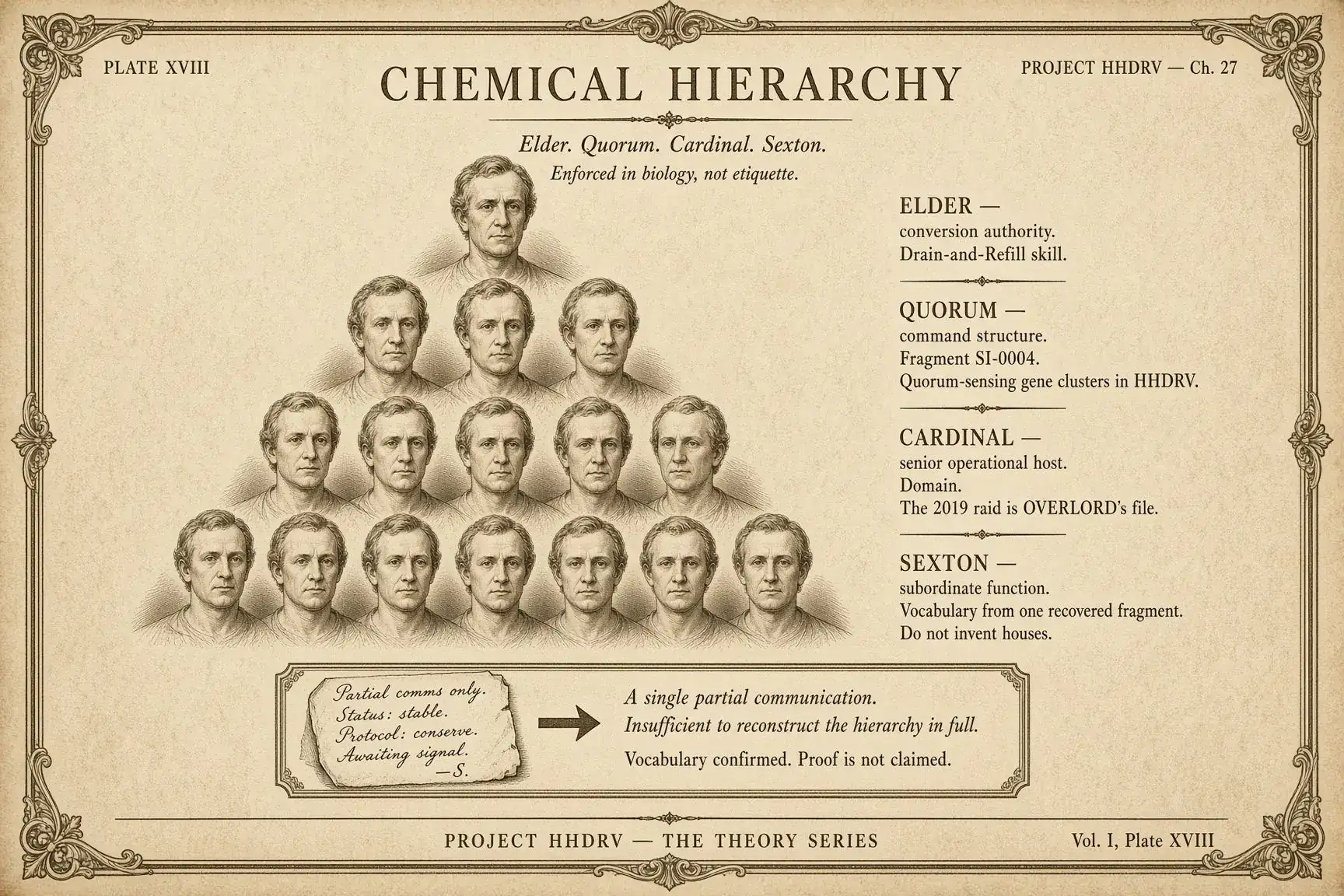
Elders. Bloodlines. A court of the night.
Table of contents
Part One — Genesis
Part Two — Anatomy
Part Three — Metabolism
Part Four — Adaptations
Part Five — Vulnerabilities
Parts Six–Nine
Primary documents
Full texts remain in the printed volumes. This archive names the designations so a reader can find them.
Printed appendices